Autonomous Pain Points & Strategic Challenges
Unpredictable Urban Complexity
Navigating chaotic city traffic with non-line-of-sight hazards. Traditional rule-based systems fail in edge cases like construction zones or unpredictable pedestrian behavior.
Data Ingestion Bottlenecks
Level 5 fleets generate petabytes of raw telemetry daily. Processing this "Data Deluge" for off-board training requires exascale storage and lighning-fast ingestion fabrics.
Safety-Critical Latency
A 50ms delay in path-planning can be catastrophic. On-board compute must handle massive neural inference while maintaining strict deterministic safety standards.
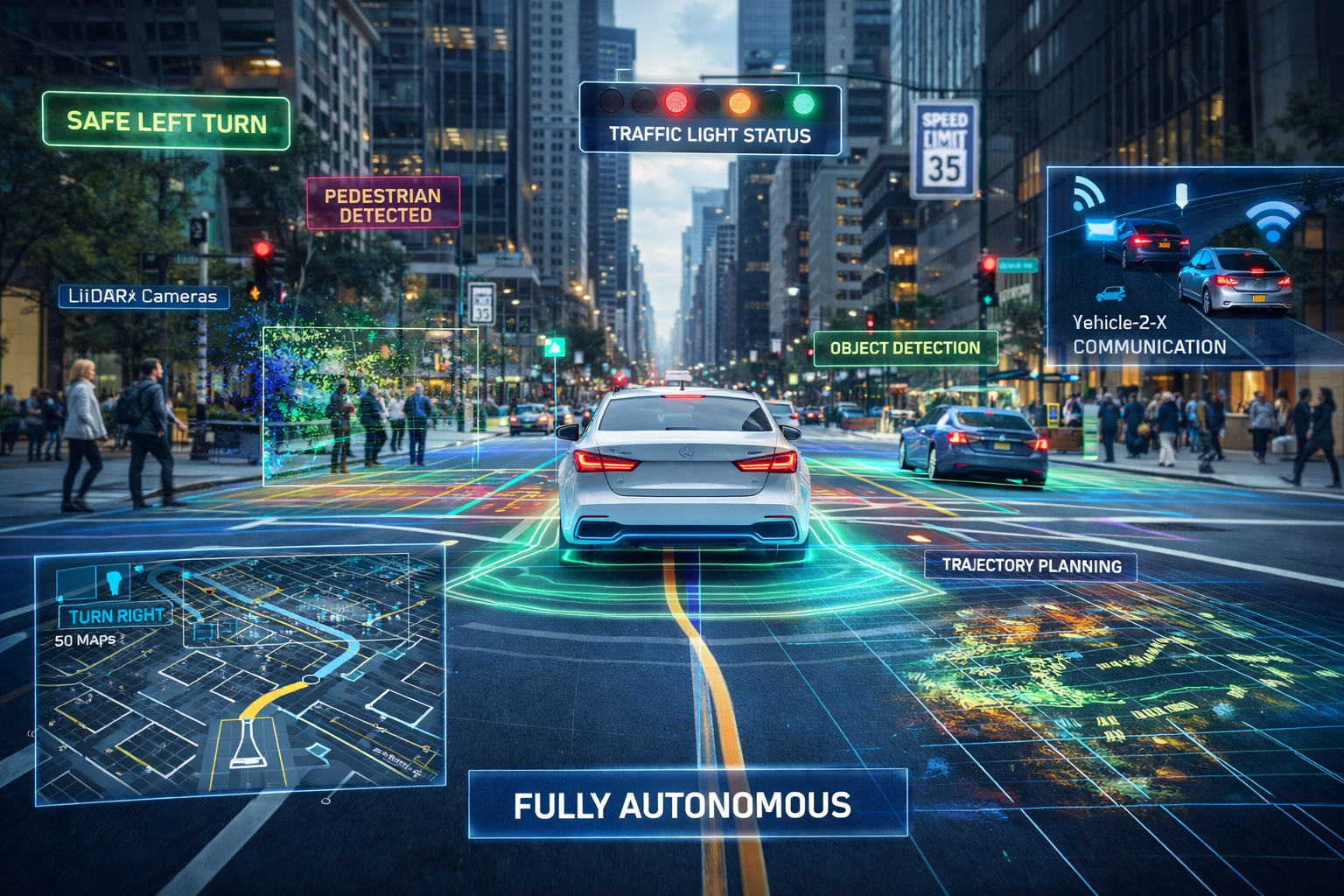
The Paradigm of Urban Autonomy
Achieving true autonomy requires more than reactive logic; it demands a high-density computational fabric capable of "perceiving" and "predicting" simultaneously. By synchronizing 360° point clouds with real-time semantic segmentation, vehicles navigate urban fabrics with superhuman reliability.
| Aspect | Assistance (L2) | Full Autonomy (L4/L5) |
|---|---|---|
| Liability | Driver responsibility | System assumes operational control |
| Compute Power | Localized ECU | High-Performance Edge-HPC Cluster |
| Navigation | GPS-dependent | HD Map & SLAM Synchronization |
The Autonomous Operational Stack
A functional pipeline for high-level self-driving capabilities.
1. Sensor Layer
Acquires raw high-bandwidth data (LiDAR point clouds, HDR video). The foundation for 360-degree environment awareness and hardware redundancy.
2. Perception & Fusion
Converts data into semantics. CNNs and Transformers classify objects (pedestrians, cyclists, signs) and merge sensors into a unified world model.
3. Localization & SLAM
Centimeter-accurate positioning by matching live sensor data with HD Maps, ensuring certainty even in "GPS-denied" urban canyons.
4. Planning Layer
Trajectory Prediction engine. Anticipates the intent of other road users and calculates collision-free paths using Reinforcement Learning.
5. Control & Actuation
Deterministic execution of the AI’s intent. Translates digital paths into physical torque and steering angles with sub-10ms response times.
The Strategic HPC & AI Backbone
- Scenario Mining Clusters: Automatic identification of "critical edge cases" from fleet telemetry.
- Shadow Mode Training: Testing new AI models in the background on real vehicles before deployment.
- Exascale Simulation: Training AI in synthetic urban environments to encounter millions of hazards virtually.
- Swarm Intelligence: Synchronizing fleet learnings instantly via the global data fabric.